Small bedroom style: should you hide or display your belongings?
Hi, it’s Julie.
In a small bedroom, it’s best to display a few carefully chosen items and hide the rest to preserve a sense of space and calm.
Visible storage can become a decorative feature, but it requires keeping things tidy. Hidden storage is easy on the eyes and protects clothes from dust. The right balance depends mainly on your habits and the space available.
What to do now
- Sort through your belongings and keep the things you use often within easy reach.
- Save open shelves for attractive items or things you use every day.
- Hide linens, out-of-season clothes, and small items in a closet or storage boxes.
- Choose sliding doors if space around the bed is limited.
- Make use of vertical space with furniture that reaches close to the ceiling.
To compare the effects of open and closed storage, you can read these tips on storage that can make a small bedroom feel cluttered and these ideas for storage that frees up space without overwhelming the room.
Visible or hidden storage: which should you choose for a small bedroom?
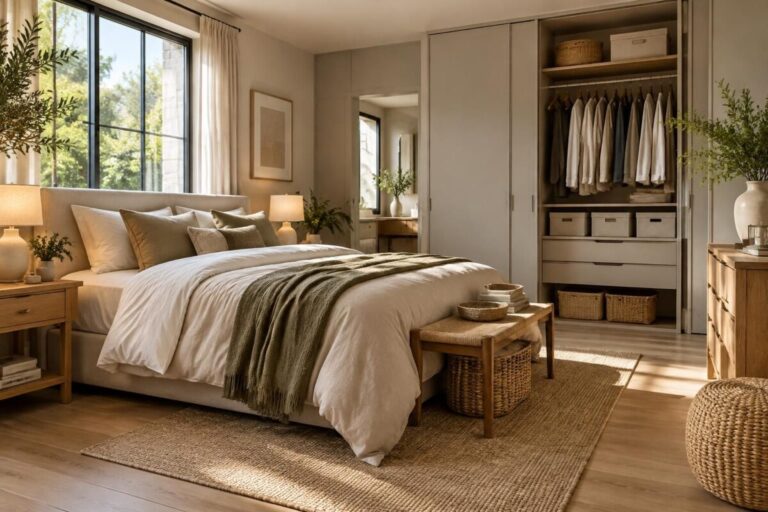
Visible storage works well if you don’t have many belongings and like seeing your clothes, shoes, or books. An open clothes rack can make the room feel lighter because it avoids the effect of a large block of doors. On the other hand, every stack and hanger stays in view, and clothes collect more dust.
Hidden storage is more restful if you want a tidy bedroom without having to put everything back in order every day. A closed closet also protects textiles from light. To keep the décor from feeling heavy, choose simple fronts, ideally in a color close to the walls.
| Option | Advantages | Things to consider |
|---|---|---|
| Visible storage | Quick access, decorative effect, sense of lightness | Requires regular tidying and leaves belongings exposed to dust |
| Hidden storage | Neat appearance and better-protected clothes | Can feel imposing if the furniture is too deep or dark |
| Mixed solution | Displays a few items and hides the rest | Requires clearly defining each area |
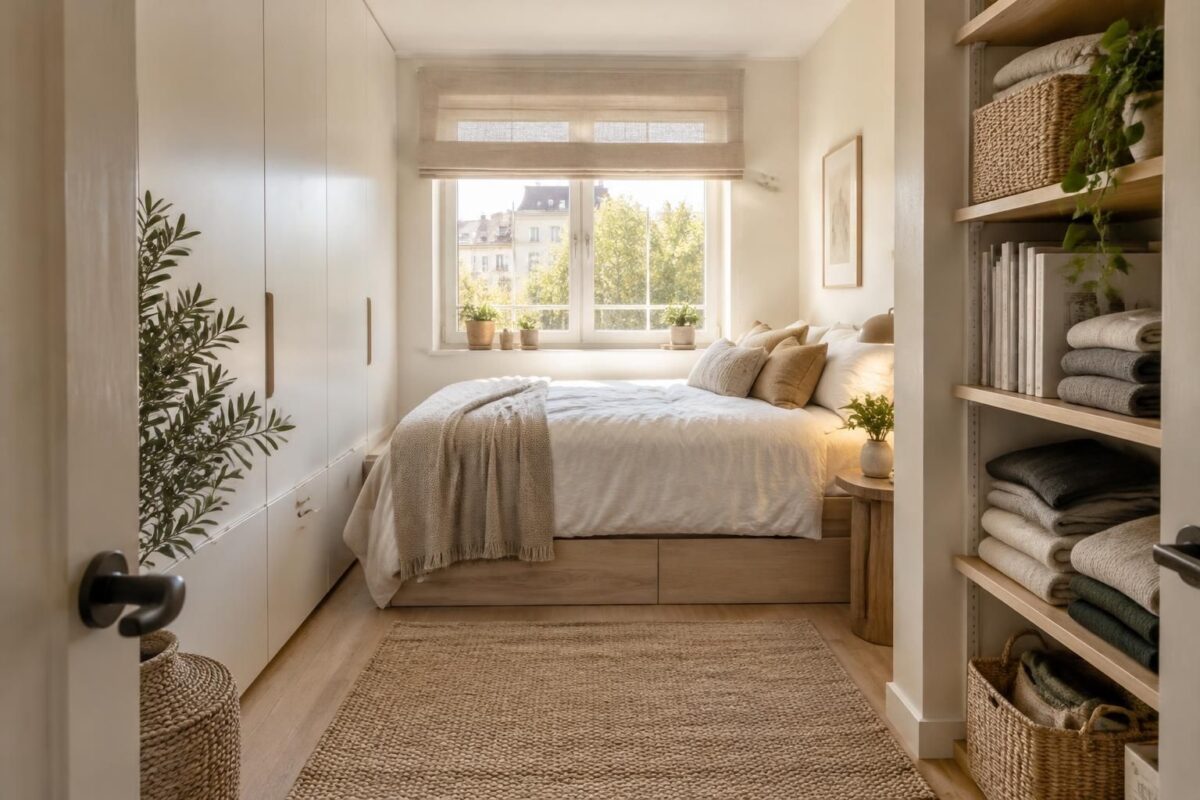
In a narrow room, sliding doors eliminate the clearance needed for hinged doors. An integrated mirror can also reflect light and make the space look larger. Making the most of your space depends as much on the choice of door fronts as on how many belongings you keep.
A mixed solution to keep the style without displaying the clutter
Imagine Léa, who has a small bedroom and chooses her outfits every morning. She keeps an open rail for her favorite clothes, while sweaters, bed linens, and seasonal items are stored behind doors. A few matching baskets hold accessories that can easily end up lying around.
This combination gives the room character without turning every storage area into a permanent display. For a minimalist style, limit displayed items to just a few pieces and stick to a consistent color palette. Decluttering then makes visible storage easier to live with.
Three steps to organize your belongings
- Sort by how often you use things. Separate everyday clothes, occasional-wear pieces, and out-of-season items. Store the latter up high or under the bed in closed storage boxes.
- Give each area a purpose. Keep frequently worn clothes within easy reach. Save open shelves for items you want to display and closed units for less decorative belongings.
- Check the flow of movement. Keep the space around the bed as clear as possible. If a piece of furniture gets in the way or reduces floor space, replace it with a shallower or wall-mounted option.
The principle is simple: display what contributes to the atmosphere, hide what creates visual clutter, and keep essentials accessible. A small bedroom feels more harmonious when every item has a designated place.
When should you choose an open or closed wardrobe?
An open wardrobe can work well if you have a limited wardrobe, the room is bright, and you like keeping your clothes well organized. It gives you immediate access to your belongings and can replace a bulky piece of furniture, as long as you don’t overcrowd it.
A closed wardrobe is often more practical if you want to hide stacks of clothes or protect textiles. In a very small bedroom, a tall closet with sliding doors makes use of vertical space without requiring clearance to open. The important thing is to choose dimensions that suit the walkway rather than adding storage at the expense of comfort.
You can also follow a simple rule: keep a few clothes, accessories, or decorative items visible, then close away the rest. This compromise works in many layouts and helps keep your bedroom welcoming every day.
Is an open wardrobe suitable for a small bedroom?
Yes, if the bedroom is bright, your wardrobe is limited, and your clothes are put away regularly. To avoid visual clutter, display only some of your belongings.
How can you hide clutter without adding a large closet?
Use storage boxes, drawers under the bed, or a small closed cabinet. Door fronts in colors close to the walls blend more easily into the décor.
Do sliding doors save space?
They don’t need clearance to open, unlike hinged doors. They’re therefore practical when the bed or another piece of furniture is close to the closet.
What can you leave on open shelves?
Keep a few books, baskets, accessories, or neatly folded clothes there. Limiting the number of items and coordinating colors helps maintain a sense of order.
Thanks for reading! Feel free to share your thoughts in the comments. — Julie