Corner furniture: a good idea or wasted space?
Hi everyone, Julie here. Corner furniture is a good idea if its dimensions and purpose suit the room; otherwise, it can quickly get in the way. To get your interior layout right, measure the corner and choose a specific function: storage, a desk area, or a TV stand. In small spaces, this approach helps save space without sacrificing ergonomics. The right piece of furniture turns a forgotten nook into a useful, harmonious area.
Things to do first:
- Measure both walls that form the corner, as well as the available height.
- Decide on the primary use before choosing the furniture.
- Make sure it doesn’t block a door, a drawer, or a frequently used passageway.
- Compare open and closed models based on what you want to store.
- Choose a finish that goes with your interior decor.
A well-chosen corner unit can provide genuine corner storage while keeping the room pleasant to live in. To explore suitable layouts, check out these tips on corner furniture and available space and these ideas for furnishing a small living room with compact furniture.
Corner furniture: when it really saves space
A corner unit is useful when it makes use of a difficult area without encroaching on walkways. In the living room, a shallow bookcase can hold books and decorative items. In an entryway, a small console provides a place for keys without taking up an entire wall.
The result depends mainly on the shape of the corner and the depth of the furniture. An overly wide model can leave an unusable gap behind it or make storage difficult to access. Making the most of your space therefore starts with everyday use, not with the desire to fill every nook.
Adapting corner furniture to each room
In a kitchen, rotating baskets make it easier to reach items stored at the back of a cabinet. In a bathroom, a wall-mounted shelf makes use of vertical space without cluttering the floor. For a home office, a corner desk can create a compact work area, as long as there’s enough room to sit comfortably.
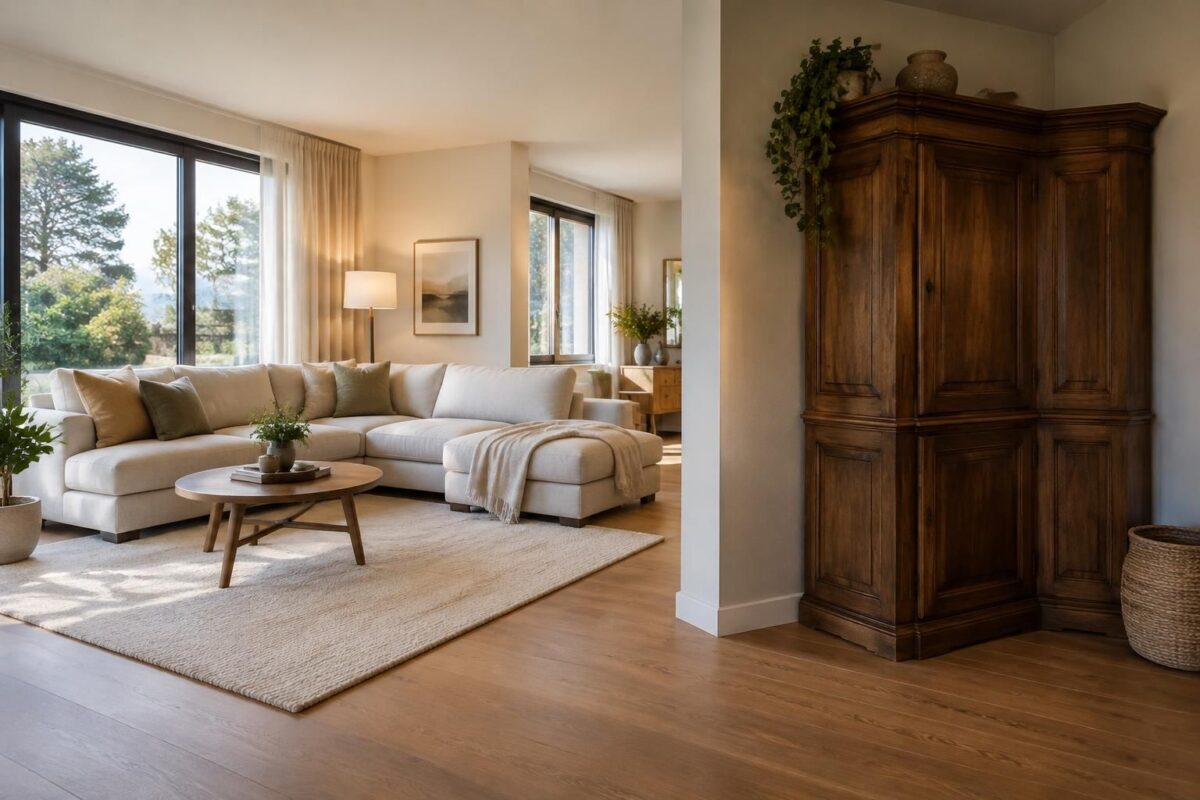
In a bedroom, a corner wardrobe or chest of drawers can free up a wall for the bed. In a living room, a corner TV stand works well if the screen is comfortably positioned for viewing from the seating area. Every room calls for a different solution: functional furniture should meet a specific need.
Choosing corner furniture without cluttering the room
Before buying, measure the width of both sides, the height, and the available depth. Also consider power outlets, skirting boards, and door clearance. For comfortable passage, aim for about 60 to 80 cm of clear space, depending on the layout and the household’s habits.
Open furniture often creates a lighter feel, but it needs to be kept tidy. Closed models hide visual clutter, but can take up more space. The right balance is to choose storage solutions suited to the things you actually use.
Simple guidelines for comparing dimensions
| Type of furniture | Approximate depth | What to check |
|---|---|---|
| Shelf or bookcase | About 25 to 40 cm, depending on the model and situation | Stability and access to books |
| TV stand | About 35 to 50 cm, depending on the model and situation | Screen size and cable routing |
| Corner desk | About 50 to 70 cm, depending on the model and situation | Room for your legs and chair |
| Bathroom storage | About 20 to 35 cm, depending on the model and situation | Door clearance and exposure to moisture |
These measurements provide a starting point, not a universal rule. An irregular corner or a narrow room may call for a custom-made piece or a modular model.
Get your interior layout right in three steps
- Step 1: Measure both walls and note any obstacles. If the corner isn’t square, make a cardboard template to test the floor footprint.
- Step 2: Choose the function and compare furniture with suitable dimensions. Also check that stored items will be easy to access.
- Step 3: Set up the furniture, then test movement around it and make sure doors can open. Adjust the decor and cables to keep everything neat.
If it’s a studio apartment, choose a compact, versatile piece of furniture to keep the center of the room clear. If it’s a family living room, a larger corner unit can define the relaxation area, as long as it leaves a clear passageway.
A story that shows why measurements matter
In a small living room, a TV stand seemed like a perfect fit on paper, but its angle didn’t match the walls. Once the template was laid on the floor, the problem became clear before the purchase, and choosing a less deep model made it possible to keep the walkway clear.
“A useful corner should still be easy to live with.” This rule sums up the balance between aesthetics, ergonomics, and storage.
Interior decor: keep the corner light rather than cluttered
Corner furniture naturally draws the eye to an area that’s often overlooked. A light wood finish or slim lines can help it blend in, while a contrasting material can make it a decorative feature. However, avoid piling things onto the shelves: a few carefully chosen pieces often make more of an impact than an overcrowded storage area.
In a dark corner, a lamp or soft lighting can make the space more inviting. For a TV stand, plan for cable grommets or a cable management solution. Practical details contribute to a tidy look just as much as the choice of furniture.
This video can help you picture different ways to make use of a corner without making the room feel crowded.
Corner furniture: mistakes to avoid
- Choosing without measuring: the furniture may stick out or leave a nook that’s hard to clean.
- Picking a model that’s too deep: it narrows the passageway and can throw the room off balance.
- Forgetting about everyday use: storage that’s hard to access quickly becomes impractical.
- Overloading the shelves: the corner loses its lightness and usefulness.
- Ignoring the height: an overly imposing piece can make a small space feel cramped.
Corner furniture is neither a magic solution nor automatically a waste of space. It works when its dimensions, purpose, and impact on movement are all considered together.
Is corner furniture suitable for small spaces?
Yes, as long as it’s in proportion to the room and doesn’t block walkways. A compact or multifunctional model can free up a wall and make use of an unused corner.
What depth should I choose for a corner unit?
It depends on its function and the model. A shelf can be shallow, while a desk needs more room for comfortable working. Always measure the remaining walkway.
How do I furnish a corner that isn’t square?
Measure both walls and make a cardboard template to test the shape on the floor. A modular or custom-made model may also work.
Is corner furniture necessarily cheaper?
Not necessarily. The price varies according to the materials, dimensions, and finishes. Compare the cost with the intended use and storage capacity.
Thanks for reading; Julie. P.S.; Leave a comment, and I’ll get back to you as soon as possible!