Furniture on casters: flexible or quickly unstable?
Hello, it’s Julie.
Furniture on wheels is practical and can stay stable when its wheels, load, and placement are chosen carefully.
It makes it easier to move things around indoors, especially in small spaces and multipurpose rooms. But a poorly balanced piece of furniture, or one left unsecured on a sloping floor, can quickly become a nuisance or even pose a tipping hazard. A few simple checks can help you enjoy a flexible layout without compromising home safety.
Do this right away
- Check the maximum load specified for the furniture and its wheels.
- Lock the wheels before placing or removing a heavy object.
- Put the heaviest items at the bottom to lower the center of gravity.
- Test the furniture on the intended flooring: rugs, floor joints, and slopes affect how stable it is.
- Keep it away from walkways where a bump could make it roll or tip over.
To choose a model suited to a small room, compare compact furniture and its effect on space. If you’re looking for an occasional piece instead, these ideas for occasional furniture in a cozy corner may also help you find the right balance.
Mobile or fixed furniture: choosing the right option for the way you use it
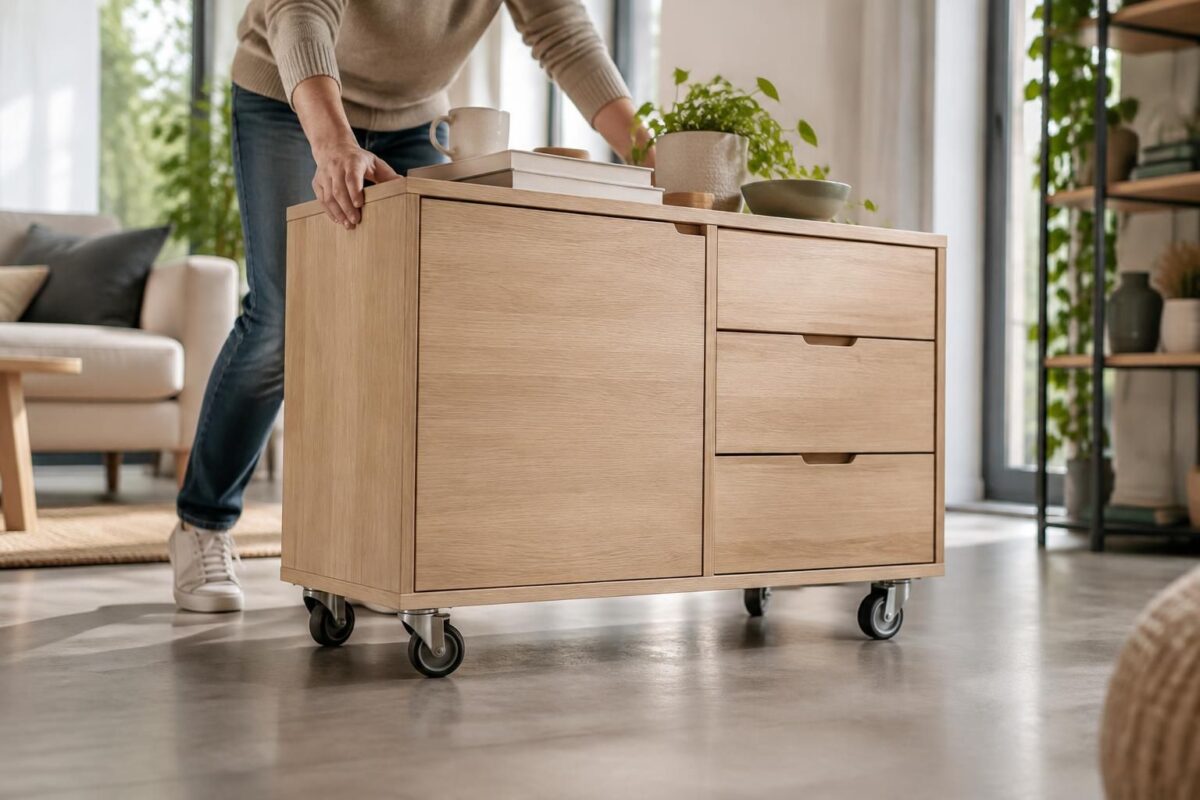
Mobile furniture is useful when a room often changes function. A serving cart can move from the kitchen to the living room, while an office cabinet can slide under a desk after work. In contrast, furniture that holds a heavy load or always stays in the same place is often better fixed in place.
The difference also comes down to the details: swivel casters make it easier to change direction, but they don’t guarantee furniture stability on their own. Effective caster brakes limit movement; they don’t make up for a narrow base or an uneven floor.
| Use | Benefit of casters | Point to watch |
|---|---|---|
| Light serving cart | Easy to move between rooms | Lock the wheels while using it |
| Office cabinet | Frees up space under the work surface | Check the load capacity and base width |
| Tall storage unit | Makes it possible to rearrange the room | Risk of tipping if heavy items are stored up high |
| Frequently moved furniture | Makes a flexible layout easier | Choose wheels suited to the flooring |
In a studio apartment, for example, a low serving cart can be used as a side table in the evening and moved back against a wall in the morning. To keep it easy to use, you need to be able to move it effortlessly, then lock it firmly in place where you want it.
Furniture stability on wheels: mistakes that matter
An unevenly distributed load makes the whole unit less stable
Stacking books, dishes, or equipment in the upper compartments raises the center of gravity. The furniture then becomes more sensitive to bumps and sudden movements, even when its wheels are locked.
Keep heavy loads at the bottom and follow the manufacturer’s stated limit. If the furniture already leans when empty, don’t use it for heavy storage: the casters won’t fix a design flaw.
Unsuitable casters make moving furniture more difficult
Swivel casters are handy for maneuvering in a tight space. On a thick rug, over pronounced floor joints, or on an uneven floor, however, they can catch or turn unpredictably. The wheels’ material and diameter matter just as much as their number.
Furniture that rolls easily on hardwood may be difficult to move on carpet. Before you buy, check that the wheels are compatible with your flooring and, if possible, test how they move with a light load.
Brakes don’t make up for poor placement
A slope, threshold, or folded rug can destabilize the furniture. Even with the wheels locked, a sideways bump could shift it if the surface isn’t level or the base is narrow.
Avoid leaving rolling furniture near stairs, a door that opens suddenly, or a busy walkway. For a tall or heavy storage unit, or one accessible to children, choose a model designed to be secured to the wall.
Choosing flexible furniture without compromising safety
Before buying, picture the furniture’s route and the items it will carry. A serving cart that needs to turn around a table has different needs from a cabinet designed to stay under a desk.
To guide your choice, first look at the base width, the quality of the joints, and whether several wheels have brakes. A lower, wider piece of furniture is generally less prone to tipping than a tall, narrow model, provided you stay within its maximum load capacity.
Three steps for checking rolling furniture
- Inspect the design. Check the maximum load, the strength of the fastenings, and the base width. Make sure the brakes are accessible and easy to operate.
- Test it on your flooring. Move the furniture while empty, then with a light load. Check that it rolls without catching and stays still when the brakes are engaged.
- Set it up carefully. Put heavy items at the bottom, lock the wheels when it’s stationary, and keep it away from walkways. If the storage unit is tall or heavily loaded, choose an appropriate wall mounting.
This check takes very little time and helps avoid a lot of hassles. The right choice isn’t necessarily the most mobile piece of furniture, but one that moves when you need it to and stays stable once it’s in place.
Practical questions about furniture on wheels
Are caster brakes enough to stabilize a piece of furniture?
They limit movement, but they don’t correct a sloping floor or a base that’s too narrow. Distribute the load properly and place the furniture on a level surface.
Can you install casters on any piece of furniture?
No. The furniture must be able to support the load and have a base sturdy enough to accommodate the fastenings. Also check that the wheels are compatible with the flooring.
How can you reduce the risk of tipping?
Store heavy items at the bottom, avoid overloading the furniture, and secure tall or unstable models to the wall when their design allows it.
Which casters should you choose for hardwood flooring?
Choose wheels suited to hard floors that can roll without marking the surface. Check the manufacturer’s recommendations and test the furniture in an inconspicuous area.
Thanks for reading! If this topic resonates with you, share your experience in the comments. — Julie